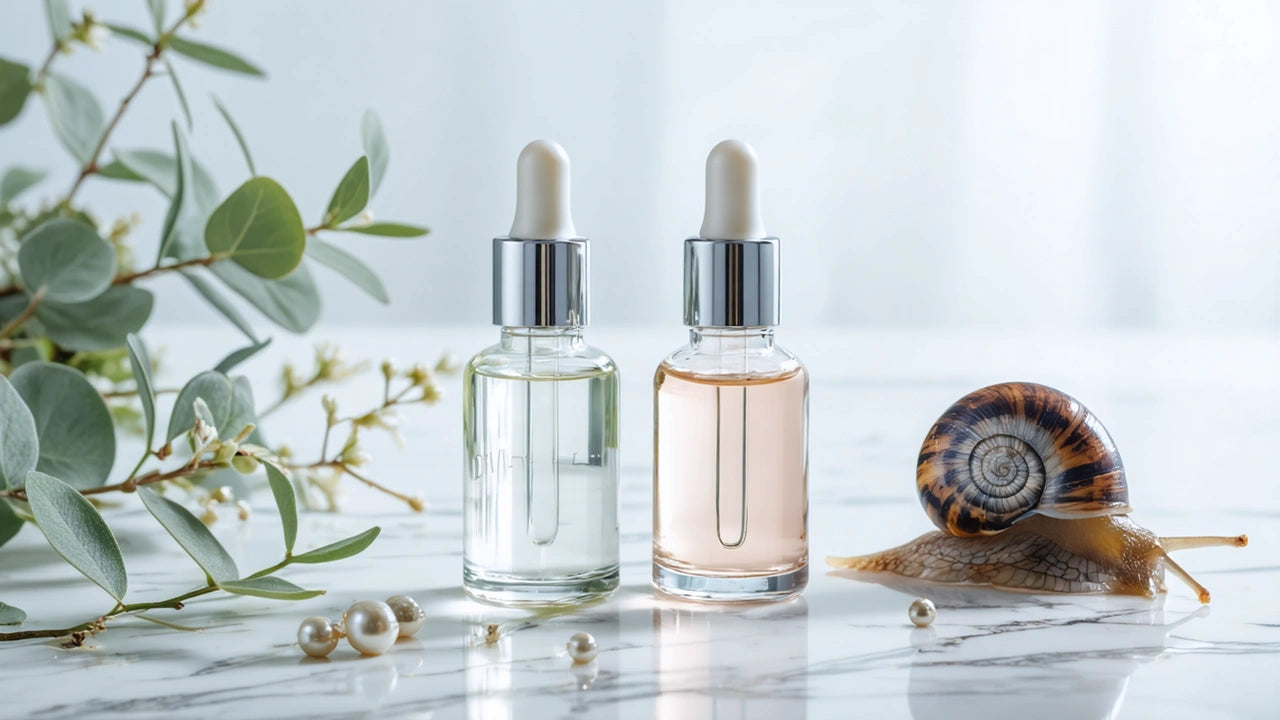

Here's the spoiler you came for: in the debate of hyaluronic acid vs snail mucin which is better, you don't actually have to pick a side — the smartest move is to layer both. Hyaluronic acid is a humectant molecule that pulls water to the surface of your skin for instant, lightweight plump. Snail mucin (snail secretion filtrate) is a nutrient-rich complex of glycoproteins and polysaccharides that hydrates and supports collagen and barrier repair over time. One gives you a quick drink of water; the other gives you the long-game bounce. Together, they're a dream team — especially in India's sticky, humid climate where you want water-light layers, not a heavy cream sitting on your face.
Quick Answer: Do You Really Have to Choose Between HA and Snail Mucin?
The 10-second verdict
No. Hyaluronic acid and snail mucin do overlapping-but-different jobs, so they complement each other beautifully. Think of HA as your instant hydration hit and snail mucin as your barrier-loving, collagen-supporting overachiever. If your budget or shelf space only allows one, snail mucin is the more multitasking pick — but the real magic is stacking them.
Why both belong in humid climates
In humid Indian summers and monsoon months, your skin can feel oily on top yet dehydrated underneath. Water-light hydration layers respect that balance far better than a thick occlusive cream. Both HA and snail mucin sink in fast and leave that bouncy, dewy finish — the same finish everyone's chasing when they talk about glass skin at home. Two lightweight layers beat one heavy one when the air is already doing the sweating for you.
Hyaluronic acid hydrates the surface of your skin by drawing in water for instant plump, while snail mucin hydrates plus supports collagen production and barrier repair for longer-lasting bounce. Because they work at different depths and in different ways, layering both — HA first on damp skin, snail mucin to seal — is the ideal approach for lasting, humidity-friendly hydration.
What Does Hyaluronic Acid Actually Do for Your Skin?
A surface hydration magnet
Hyaluronic acid is a moisture magnet. It grabs water from your product and the surrounding air and holds it against your skin, softening the look of fine dehydration lines almost instantly. Different molecular weights sit at different depths — smaller fragments travel a little deeper, larger ones smooth the very top — which is why good formulas blend a few sizes together.
Best for plumping, quick
If you want that "I just drank three litres of water" look before an event, HA is your fastest friend. It's the instant-gratification active — you'll feel the surface plump within minutes. But instant surface hydration is exactly that: surface-level. It doesn't rebuild your barrier or nudge collagen, which is where snail mucin steps in.
The humidity note you can't skip
Here's the catch India-dwellers need to know: in very dry air — hello, cranked-up office AC or a dehumidified bedroom — HA can pull moisture out of deeper skin if there's nothing to grab from the air. Always apply it on damp skin and seal it with something on top. Cosmetic scientists note that unsealed humectants in low-humidity environments can worsen dehydration, so that seal step isn't optional. For anyone stacking HA with other actives, our guide to layering snail mucin with niacinamide and HA breaks down the exact order.
What Does Snail Mucin Bring to the Table?
Hydration plus a collagen boost
Snail mucin is the multitasker of the two. Snail secretion filtrate is naturally packed with glycoproteins, glycolic acid, allantoin, and hyaluronic-acid-like polysaccharides — so it hydrates and does more. Its glycoprotein content is why it's linked to supporting your skin's own collagen environment, giving you firmness and bounce that builds with consistent use rather than washing off by evening.

Our 96% Snail Mucin Collagen Boost Serum pairs that mucin with niacinamide and hyaluronic acid, so you get the hydration-plus-collagen combo in a single water-light layer — very on-brand for humid days.
Barrier repair that lasts
The allantoin and glycoproteins in snail mucin are known for soothing and supporting the skin barrier — the thing that keeps moisture in and pollution and grime out. Research published in cosmetic dermatology literature found that snail secretion filtrate improved skin hydration and the appearance of texture over several weeks of use, pointing to benefits that go beyond a quick surface fix. For pollution-heavy Indian cities, a happy barrier is your quiet daily hero.
The bouncy glow
That signature "just-facial" bounce? That's snail mucin's glossy, cushiony finish. It's the reason it became a K-beauty obsession — and why it plays so nicely under sunscreen and makeup without feeling sticky.
Head-to-Head: Texture, Skin Type and Results Compared
Here's the snail mucin vs hyaluronic acid comparison at a glance, so you can match it to your skin instead of guessing.
| Factor | Hyaluronic Acid | Snail Mucin |
|---|---|---|
| Main job | Surface hydration | Hydration + collagen support + barrier repair |
| Texture | Water-light, quick-absorbing | Light gel-serum, slight cushiony slip |
| Speed of results | Instant surface plump | Builds over weeks (long game) |
| Best for | Quick pre-event glow, dehydrated skin | Barrier repair, firmness, all-day bounce |
| Oily skin | Great — no oil, pure water | Great — lightweight, non-greasy |
| Sensitive skin | Generally very friendly | Soothing (allantoin), generally very friendly |
Oily vs dry skin
Both are oil-free hydration, so oily and combination skin can enjoy either without a greasy film. Dry skin will love layering the two and sealing with a moisturiser.
Speed vs the long game
Want it now? HA. Want it to last and build? Snail mucin. Want both? Layer — that's the whole point of this post.
Sensitive skin
Both are considered gentle and sensitive-skin-conscious. Snail mucin's allantoin adds a soothing edge, which is why it suits reactive, easily-flushed skin. As always, patch test first if you're introducing something new.
How Do You Layer Snail Mucin and Hyaluronic Acid Step by Step?
This is layering snail mucin and hyaluronic acid the easy way — the Quench Botanics Method for humidity-smart hydration is all about thin, water-light layers in the right order. Dermatologists recommend applying humectants onto slightly damp skin so there's water available to bind.
- Cleanse and leave skin damp. Don't towel-dry to bone-dryness — a little moisture on the skin gives your humectants something to work with.
- Apply hyaluronic acid first. A few drops or a thin layer of an HA serum onto that damp skin, patted in gently.
- Seal with snail mucin. Follow with 3–4 drops of your snail mucin serum, pressing it in with your palms. This layer locks the HA's water in and adds its own collagen-supporting, barrier-loving benefits.
- Lock it with a gel moisturiser. Top with a lightweight gel moisturiser to seal the whole routine — heavy creams are optional and often overkill in humid weather.
- AM: finish with SPF. Never skip sunscreen in the morning; hydration and sun protection are a package deal.
This works both AM and PM. In dry winter months or heavy AC, add a richer moisturiser on top. In peak humidity, keep it to the serums and a gel.
For Indian skin in the Fitzpatrick III–V range dealing with tanning, pigmentation and pollution, a well-hydrated, intact barrier is what helps your brightening actives (like niacinamide or vitamin C) work more comfortably — so this hydration base is doing quiet, foundational work every single day.
New to snail mucin? Start small
If you've never tried it, a mini is the low-commitment way to see how your skin loves it before you size up.
Frequently Asked Questions About hyaluronic acid vs snail mucin which is better
How long does it take to see results from snail mucin?
Most people see visible results from snail mucin in 4 to 6 weeks of consistent daily use. In the first 1-2 weeks you'll notice an immediate plumped, dewy glow and less tightness, since snail mucin hydrates and soothes right away. The deeper perks — smoother texture, faded post-acne marks, and a stronger skin barrier — build gradually as its glycoproteins and growth factors support repair over time. Consistency is everything here, so apply it twice daily and give it a full skin cycle before judgi
Is hyaluronic acid safe for sensitive skin?
Yes, hyaluronic acid is generally very safe and gentle for sensitive skin. It's a humectant that naturally occurs in your body, so it rarely triggers irritation, stinging, or breakouts. It simply draws water into the skin to hydrate and soothe, making it a great pick for reactive or easily upset skin types. One tip: apply it to damp skin and seal it with a moisturiser, especially in dry climates, so it pulls water into your skin rather than out of it. Always patch test any new product first.
What are the benefits of using snail mucin in your skincare routine?
Snail mucin offers hydration, barrier repair, and skin-smoothing benefits all in one ingredient. It's rich in glycoproteins, hyaluronic acid, glycolic acid, and peptides that hydrate deeply, calm irritation, fade post-acne marks, and boost bounce over time. It also supports your skin barrier, which helps reduce redness and sensitivity. Because it's lightweight and non-greasy, it suits most skin types, including oily and combination skin. Think of it as a multitasker that hydrates now and helps y
Can you use snail mucin with vitamin C?
Yes, you can use snail mucin with vitamin C, and they actually complement each other beautifully. Apply your vitamin C serum first on clean skin for its brightening and antioxidant benefits, then follow with snail mucin to hydrate, soothe, and lock everything in. Snail mucin can even help buffer any tingling from stronger vitamin C formulas, making the combo more comfortable for sensitive skin. Wait about a minute between layers so each absorbs properly, then seal with moisturiser and SPF in the
What is the difference between a humectant and an occlusive?
A humectant draws water into your skin, while an occlusive seals that water in to prevent it from escaping. Hyaluronic acid is a classic humectant — it attracts moisture from the environment and deeper skin layers to hydrate the surface. Occlusives, like squalane, shea butter, or petrolatum, form a protective layer on top that locks hydration in. The two work best as a team: apply a humectant on damp skin, then an occlusive or moisturiser on top. Without an occlusive step, a humectant can actual
Shop Quench Botanics
Ready to build your layered-hydration base? Reach for the 96% Snail Mucin Collagen Boost Serum for that hydration-plus-collagen bounce — and if you'd rather dip a toe in first, the Snail Mucin Serum mini is the perfect first-timer size to test the glow. Layer it over your HA on damp skin, seal with a gel moisturiser, and let humid India work with you, not against you. Your barrier will thank you.